Wanamaker Lewis Brings Blues and Roots to Fitler Square
The longtime Philadelphia musician reflects on Carnegie Hall, charcoal portraiture and a lifetime of teaching himself new crafts.
By Yianni
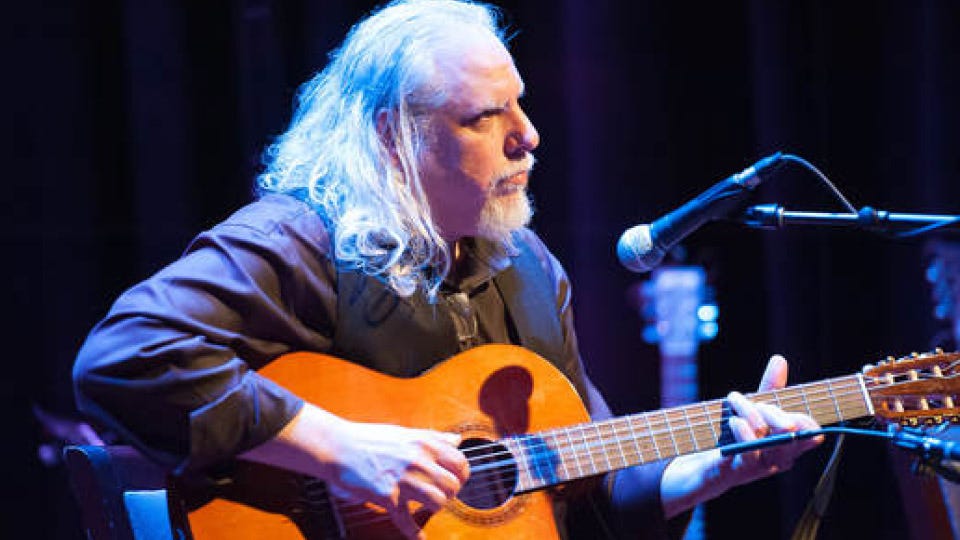
When Wanamaker Lewis takes the stage in Fitler Square on Friday, Aug. 7, he will be returning to a part of Philadelphia he once called home. Lewis spent a stretch at 22nd and Pine, only a few blocks from the park. He will arrive with decades of Philadelphia music behind him and the self-taught curiosity that has carried him from bluegrass banjo to charcoal portraiture.
From 6 to 8 p.m., Lewis and Rustic Music Service will play blues and roots music. “It’s going to be lively and listener-friendly,” he noted.
In 1980, Lewis stood at Carnegie Hall waiting for his knees to stop shaking. John Herald had called him in for the concert. Lewis had played with the John Herald Band from 1976 to 1980. Herald came out of the center of the Greenwich Village folk revival.
He co-founded the Greenbriar Boys, the group a 20-year-old Bob Dylan opened for during a 1961 run at Gerde’s Folk City. Nearly two decades later, Lewis was beside Herald at Carnegie Hall. Once his nerves settled, the prestige of the room fell away. What Lewis remembers is its sound: the hall responded so honestly that the microphones felt almost redundant.
Later that year, Lewis found himself in another place charged with anticipation: Veterans Stadium for Game 6 of the World Series. Steve Carlton started for the Phillies, carrying a 4-0 lead into the eighth before Tug McGraw took over.
With two outs in the ninth inning, the Phillies were one strike from their first championship. The crowd had not celebrated yet, but Lewis could feel it waiting. “You could just feel the anticipation and excitement,” he said. “It was very palpable.”
When the final strike arrived, the roar was released. Lewis and his friends headed toward South Street, where the celebration had filled the road. At Carnegie Hall, every note came back. At the Vet, an entire city seemed to hold its breath.
What connects the two memories is Lewis’s attention to an atmosphere: the way sound gathers, returns or waits to be released. That attention has also found a quieter outlet. These days, Lewis draws charcoal portraits, studying a face feature by feature until the likeness begins to answer back. “It actually is my Zen,” he reflected. “I don’t even worry. I don’t even think about music or playing. It takes me into [the drawing] totally for an hour, an hour and a half.”
Lewis was born in Philadelphia and raised in East Oak Lane, where he lives and teaches today. His path through music was shaped less by formal training and more by the confidence that he could figure things out. “Everything I do, I’m an autodidact,” he said. After learning a clawhammer style of banjo, he wanted to play bluegrass but could not find anyone to teach him.
So he sat down with an Earl Scruggs instruction book, listened to recordings and matched the notes he heard to the tablature on the page. Eventually, he learned to play what he had at first only been able to hear.
That instinct for teaching himself did not stop at music. Lewis’s mother, who he said had artistic talent of her own, ran a Philadelphia restaurant called Ellen Rose. When they turned some of her dressings and pesto sauces into retail products, Lewis taught himself how to market them: he made appointments, carried samples into stores and got the products onto shelves at Wegmans, Genuardi’s and other grocers.
Without a large marketing budget, the products never reached a much larger market. “We had a very strong but small following,” Lewis explained. “The people that loved us loved us. But we couldn’t break into the larger public.” Through it all, Lewis continued to play.
Drawing began almost by accident in December 2016. On a snowy day, Lewis picked up a photograph of himself and tried to draw it. The portrait came out better than he expected, so he posted it to Facebook. The response persuaded him to keep going.
Soon he was drawing recognizable public figures in charcoal, leaving their names off the posts and using the comments as a test. If people could identify the subject, he knew the likeness worked. “I let them tell me,” he said.
Lewis does not use grids, and he has never taken a formal art class. He starts at the side of a face and measures one feature against the next: an eyebrow, the nose, then the other eye. He calls it his “this-to-that method.” As with the Scruggs book, he has taught himself through close observation: look, compare, adjust and try again.


On the page, Lewis is the one doing the close looking. Onstage, he knows what it feels like when that attention comes back from the room.
In bars, a band could become part of the scenery beneath a television. “Sometimes just playing for the local crowd…was really satisfying,” Lewis said. Fitler Square will not offer Carnegie Hall’s acoustics or the Vet’s roar. Lewis hopes to find a neighborhood crowd willing to stop and listen.
The Fitler Focus is a reader-supported publication.
To receive new posts and support our work,
consider becoming a free or paid subscriber.


