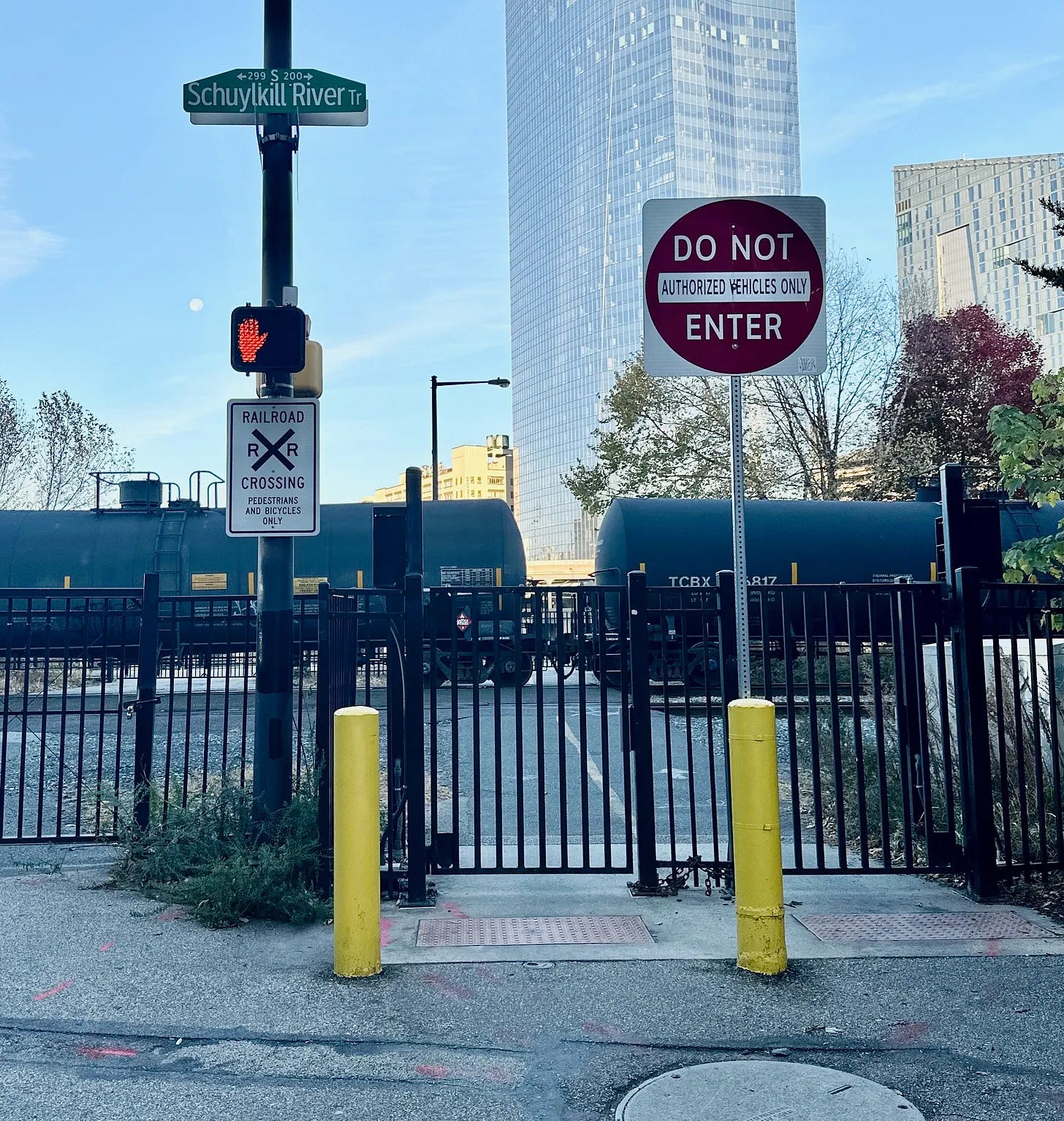
What Runs Beside the Trail? City and CSX Withhold Hazardous Rail Cargo Details
The City of Philadelphia has refused to disclose what hazardous materials move daily along the CSX rail corridor beside Fitler Square, citing public safety concerns.

After a massive sinkhole shuttered a stretch of the Schuylkill River Trail last summer, some Fitler Square residents began looking across the river with new unease. Freight trains rumble daily along the CSX corridor in Fitler Square, just yards from dense residential towers and one of the city’s busiest recreational paths.
What, readers asked, is moving on those rails? And if something went wrong, how prepared is the city?
Our reporting, including a Right-to-Know request and interviews with both CSX and a Temple University hydrogeologist, reveals a system that is heavily inspected and tightly coordinated with emergency responders.
It also revealed a firm refusal, by both the railroad and the City of Philadelphia, to disclose what hazardous materials move through this corridor.
A Request Denied
In November, The Fitler Focus filed a Right-to-Know request for records detailing what hazardous materials move along Fitler Square’s CSX corridor, and how the city plans for emergencies along that stretch.
The city denied the request in full.
Deputy City Solicitor Edward H.V. Skipton III wrote that the records, if released, would implicate public safety concerns. The city said disclosure would be “reasonably likely to jeopardize or threaten public safety” or endanger infrastructure security.
The denial means residents cannot see how frequently hazardous materials move through the corridor, or what emergency planning documents say about rail-specific risk.
Prepared for Emergencies, Silent on Shipments
In a phone interview, Austin Staton, director of media relations for CSX, confirmed that the railroad does not disclose hazardous material shipments by specific route.
“That’s a Homeland Security issue,” Staton said, explaining that after 9/11, railroads stopped publicly identifying where certain hazardous materials travel.
CSX provides information to state and local emergency response agencies, including yearly reports on specific commodities, Staton said. Those reports are shared with first responders on an annual basis but are not made public.
In the event of a derailment involving hazardous cargo, Staton described a robust internal emergency process. CSX maintains a centralized dispatch center that can quickly identify which cars are involved and what materials they contain. From there, notifications go to the company’s hazmat team, railroad police, and local first responders, with additional state and federal notifications depending on the material.
On railway inspections and maintenance, CSX was more forthcoming. Every track segment is inspected at minimum once per week, Stanton said. Inspections increase after severe weather or instability events.
At the statewide level, CSX’s 2024 Pennsylvania fact sheet shows that the majority of freight volume is coal and intermodal traffic, together accounting for roughly three-quarters of shipments by volume. The company moves 478,382 carloads annually across 2,006 track miles in Pennsylvania.
What portion of that traffic through Center City includes hazardous materials remains undisclosed. “It’s not from a lack of transparency,” Staton said. “It’s a national security issue.”
The Science Beneath the Trail
The sinkhole that closed part of the Schuylkill River Trail prompted the renewed scrutiny. But geologically, it is unlikely to reflect the kind of deep, dissolving-bedrock collapse seen in places like Lancaster County or Florida.
“[The Schuylkill River Trail] is not vulnerable to geologic sinkholes,” said Dr. Laura Toran, professor emeritus of hydrogeology at Temple University.
Philadelphia does not sit atop the carbonate rock formations that commonly produce large, natural sinkholes. Instead, Toran said, urban sinkholes are typically anthropogenic, meaning they result from human activity. In many cases, they’re tied to leaking or failing underground pipes that gradually wash away surrounding soil.
A leak can erode sediment over time, she explained, sometimes producing subtle surface changes before a sudden collapse. In other cases, the failure appears abrupt.
Cities monitor water budgets and conduct dye and smoke tests to detect leaks, but “you can’t keep track of every inch of pipe,” Toran said, noting that pipe leakage remains one of the persistent unknowns in urban hydrology.
Whether a sinkhole poses any direct risk to adjacent rail infrastructure depends on the location and orientation of underlying pipes, she said.
Safeguards Assured, Details Withheld
CSX says it inspects the rails weekly and coordinates closely with emergency responders. The city says releasing planning documents and cargo manifests would jeopardize public safety. Both insist that safeguards are in place.
What remains unavailable to the public is concrete information about how often hazardous materials move through this corridor.
The trains run in plain view. The details of what they carry remain out of public reach.


Those hazardous materials don't just move along the trail, they often sit for hours and hours while the trains are idling, blocking the entrance to the trail at 25th and Locust. CSX uses the tracks as a parking lot. And the big gates are often chained shut which would slow down any emergency vehicles from access to the tracks.
I live near the trail and the CSX crossing for pedestrian traffic. Literally for months an irrigation shed leaked copious amounts of water flooding the area, freezing, and left unchecked. Eventually a city water employee and I discussed the shed... the worker was not aware the shed belonged to CSX and CSX was unaware of the flooding, or so they said. We expect this same entity to keep us safe from potentially lethal "accidents"?